Sending a letter, and being able to prove it went
What each way of sending a letter actually establishes, what it leaves unproven, and what there is left to keep once the letter has gone.
The principle
What counts is not the letter: it is the proof that it went
A department that receives a complaint does not argue over the text of a letter it says it never received. Nor does somebody disputing a delivery argue over the contents of a letter whose very existence has not been established. In both cases what settles the matter is not what was written: it is what can be shown.
A way of sending can establish three separate things, and rarely all three at once: that a document was sent, that it was received, and what it contained. Confusing those three proofs is the commonest mistake, and the most expensive: many people discover, at the moment they need it, that they hold proof of one thing while believing they hold proof of another.
A perfect letter you cannot prove you sent is worth nothing.
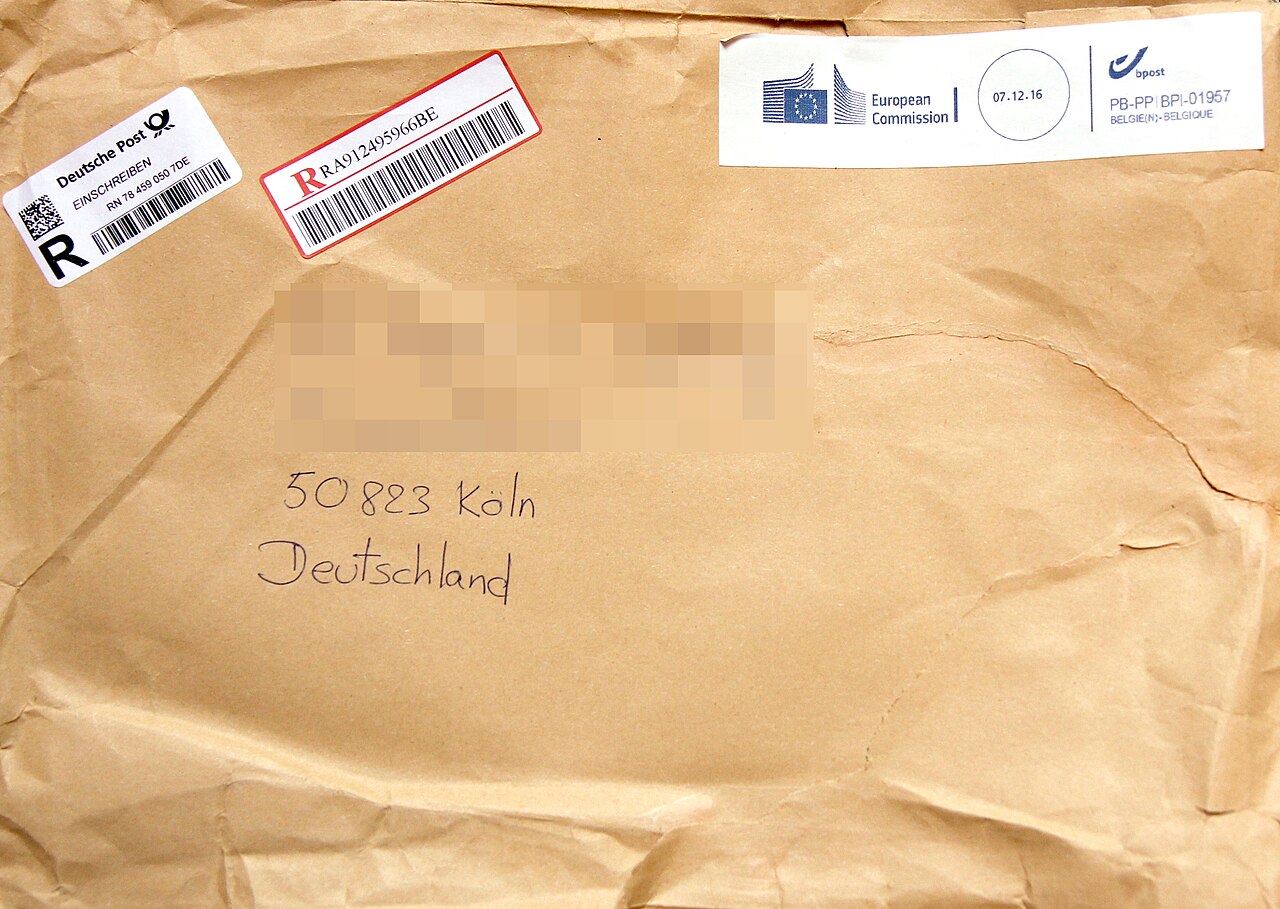

The table below takes six common ways of sending a letter, and says for each what it establishes and what it leaves untouched.
The six usual ways
What each one proves, and what it leaves unproven
| The way of sending | What it proves | What it does not prove |
|---|---|---|
| Handed over in person against a receipt | That the document was handed over, on that precise day, to the person who signed the receipt. It is that dated, signed slip you have to keep: merely remembering that you dropped a document off proves nothing. | That the person who signed had the power to decide the case, nor what exactly was in the envelope if the receipt does not describe it. |
| Registered post with acknowledgement of receipt | Posting on a certain date, then receipt, with its date and often the signature of whoever took delivery. | The exact contents of the envelope: the service carrying it does not open it and cannot vouch for what it was carrying. A copy kept separately is still needed for that. |
| Ordinary post, not registered | Little in itself: at best a date of writing if the letter carries one, and the existence of a copy if the sender kept one. | Neither sending nor receipt. Ordinary post that goes astray leaves no trace, and nothing stops a recipient denying they received it. |
| The time of sending as recorded by the sender's mail service, and the exact contents: barring a technical failure, the message sent and the message received are identical. | Receipt. An email sent is not an email read, nor even an email delivered: a delivery or read receipt can be requested, but nothing obliges the recipient to return it. | |
| Online form | Often a timestamped confirmation from the receiving service itself, sometimes with a file number: it is the receiving service that vouches for receipt, at the moment it records it. | The exact content of what was submitted, if no copy or summary is offered after sending. Without that trace, all that is left is the memory of having filled the form in. |
| Lodged at a counter | That somebody turned up and handed over a document, if a dated receipt is issued in exchange. | More or less everything, in the absence of that receipt: lodging a document with nothing handed back leaves no more trace than a spoken conversation. |
The table shows it line after line: each way fills in part of the triangle of sending, receipt and contents, and always leaves another part open. A careful practice therefore combines two proofs rather than one, for instance registered post for the date and the receipt, and a copy kept separately for the contents.
After sending
What there is left to do once the letter has gone
Proof of sending or of receipt says nothing about the contents. Four moves cover what it leaves open: keeping a copy, dating a screenshot usefully, knowing what to do with an acknowledgement that comes back, and knowing how long to keep it all.
Keep a copy, not only proof of sending
Proof of posting or of receipt establishes that an item went and that it arrived. It hardly ever says what was inside. If the contents are ever disputed, only a copy kept separately lets you show what was actually written: a copy printed before the envelope was sealed, the file saved before printing, or the text pasted into an email sent to yourself.
With an online form, that move takes a little foresight. The copy has to be taken before you submit, by a screenshot or by pasting the text you typed somewhere else, because once the form is submitted the content displayed often disappears with the page.
Dating a screenshot so that it proves something
A screenshot on its own shows only an image: nothing says it was taken that day rather than another. For it to be of use, the date has to appear in the image itself, for instance the system clock visible in the shot, or the date the site displays on its own confirmation screen, rather than a shot cropped down to the one message that looked useful.
The file name can add a second date, as a supplement and not a substitute: saving the screenshot under a name beginning with that day's date makes a folder of several items sortable in order, without having to reopen each image to find out which comes first.
An acknowledgement of receipt comes back: what to do with it
A signed acknowledgement of receipt coming back is often the strongest single item in a whole file, and yet it is the one most easily mislaid: slipped into a drawer, it soon parts company with the letter it belongs to.
The useful move is to attach it to the copy of the letter you sent, or to keep an image of it in the same folder as that copy, with the date it came back if that is not already legible on it. Tied to the chronology of the facts rather than filed apart, an acknowledgement of receipt stays usable months later, when the precise memory of sending has faded.
How long to keep it
The universal marker is easy to state, even without giving a precise period: you keep things as long as the case can still be reopened, that is, at least until the end of the period during which a challenge remains possible. That period depends on the country and on the kind of dispute: a country module gives it where one exists.
With no stated marker for your country or your situation, the careful principle is to keep things longer than necessary rather than the other way round: proof kept a year too long costs a little space, proof destroyed too early can never be made again.
One mechanism, several names
The mechanism travels, the name of the product changes from country to country
The mechanisms described above, proof of posting, proof of delivery, a signature from the recipient, exist in most countries, under different commercial names, sold by different operators. In France, La Poste calls it “la lettre recommandée avec accusé de réception” (registered letter with acknowledgement of receipt). In the United Kingdom, Royal Mail sells a tracked service with a signature, “Signed For”. In the United States, USPS offers “Certified Mail”, with a “Return Receipt” option. These are examples among others, not the default setting of this site.
The name of the product matters less than what it actually includes: basic registered post often proves posting and tracks the item on its way, without always including the recipient's signature. It is the added option, the delivery advice or acknowledgement of receipt, that brings that particular proof, and it is checked before sending, never after.
What a particular country offers, once a module exists for it.
- See the country modules the modules checked, country by country
What each neighbouring page deals with.